Vygotsky's zone of proximal development, for writing teachers
Two students turn in the same piece of writing. Same length, same competence, same grade. On every measure I have on paper, they are the same writer.
Then I sit with each of them for five minutes, and I find out they are nothing alike.
With two good questions, the first one suddenly sees a shape for the whole piece and starts talking faster than I can write it down. The second one, given exactly the same two questions, hands me the same answer again in slightly different words.
Same essay. Same grade. Completely different learners. And what separates them is the single most useful idea I know of in teaching writing.
What Vygotsky actually said
Lev Vygotsky was a Soviet psychologist who died in 1934, at thirty-seven, with most of his work unpublished. It took decades to reach English-speaking classrooms. When it did, it brought one idea that has quietly reorganized how good teachers think.
He noticed that we were measuring children wrong. A test tells you what a child can do alone, today. Vygotsky's argument was that this number, on its own, is close to useless for teaching — because it describes what has already finished growing.
His own example is the one I keep coming back to. Take two children who score identically on a test. Now give each of them a little help — a hint, a leading question, the first step done together. One of them leaps years ahead. The other moves a little. Their tested ability was identical. Their capacity to grow right now was not remotely the same.
That distance — between what a learner can do alone and what they can do with help — is the zone of proximal development. Proximal just means nearby. It is the growth that is standing right next to them, close enough to reach.
Three zones, then:
- What the student can do alone. Comfortable. Also finished. Nothing grows here.
- What the student can do with help. The zone. Everything happens here.
- What the student cannot do yet, even with help. Too far. Help here produces copying, or tears.
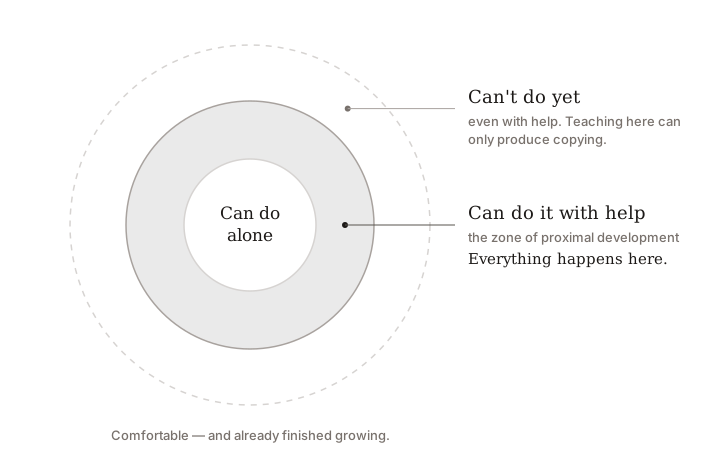
Vygotsky's claim — and forty years of classroom experience has not talked me out of it — is that instruction only does real work when it lands in zone two. Teach into zone one and you are running a review session. Teach into zone three and the student's only options are to fake it or to quit.
One footnote worth knowing, since it is the name of the thing you probably searched for: Vygotsky never wrote the word "scaffolding." That metaphor was coined by other researchers in the 1970s to describe how a tutor operates inside his zone. The zone is the territory. The scaffold is what you build to stand in it. If you want the scaffold half, I wrote a plain-English guide to what scaffolding in writing actually means.
The zone is invisible in finished work
Here is the part that changed my teaching, and it is why I opened with those two students.
You cannot see a student's zone of proximal development by reading what they wrote. Not in an essay, not in a portfolio, not in a rubric score. Finished work is a photograph of zone one. It shows you the edge of what they can already do alone.
The zone only becomes visible in interaction. It shows up in the gap between the answer a student gives you cold and the answer they give you after one good question. That gap is the measurement. There is no worksheet for it.
This is uncomfortable, because it means the assessment that matters most cannot be collected, graded, or put in a gradebook column. It happens in conversation and it evaporates. But it also means something freeing: the five minutes you spend talking to a student about their draft is not a nice extra you fit in when there is time. It is the only instrument you have that can see the thing you are actually trying to grow.
A writing student is in three zones at once
This is the piece I have never seen said plainly, and it explains a thing that used to baffle me: the student who is obviously bright and hands in a mess.
Writing is not one skill. It is a stack of them, and a student sits at a different place in that stack for each layer. Roughly:
- Having something to say. Ideas, memory, opinion, the true thing.
- Deciding what goes where. Structure, order, what the reader needs first.
- Making sentences carry it. Syntax, precision, rhythm, word choice.
A twelve-year-old is very often independent at the first layer, squarely in the zone at the second, and out past the zone at the third. She has plenty to say. She can organize it if you ask her the right question. She cannot yet make a sentence do something subtle no matter how much you coach her today.
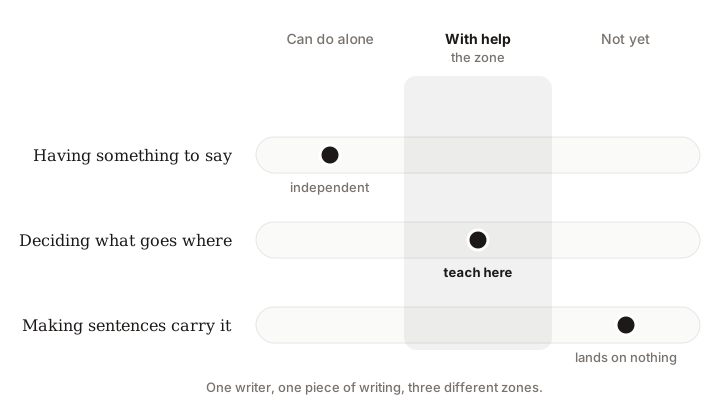
Now look at what happens when you teach without noticing this. You hand her a lesson on varying sentence structure — zone three. It does not land, because nothing is there to hold it. Meanwhile the actual growth available to her that week, in the second layer, goes untouched. She works hard. She improves at nothing. And both of you conclude she is just not a strong writer.
Split the layers and the whole picture changes. Ask yourself, for one student, on one piece: where is she independent, where is she reachable, and where am I currently wasting both our time? You will usually be able to answer it in about thirty seconds, and it will redirect the next two weeks.
For students writing in a second language this split is even sharper — the thinking layer and the language layer can sit in completely different zones, which is a whole subject of its own. I wrote about that in scaffolding writing for ESL and ELL students.
Finding the zone in a five-minute conference
This is the part to try tomorrow. It is a ladder, and you climb it one rung at a time, stopping the moment the student takes over.
- Ask an open question and wait. "What is this piece really about?" Then be quiet. Genuinely quiet — count to ten in your head. Most of us rescue a student at four seconds and never learn what they had.
- If nothing comes, narrow it. "What is the one moment in here you actually care about?" You have just made the question smaller without making the task easier.
- If nothing comes, offer a choice. "Is this about the day it happened, or about how you felt afterwards?" A choice is far easier than a blank, and it still requires them to decide.
- If nothing comes, model one and hand it back. "Some writers would start at the loudest moment and explain later. What would that look like for yours?"
Wherever the student picks it up and runs is the top of their zone that day. Note it. That rung is your teaching target for the next piece — not the rung above, and definitely not rung one, where they are already fine.
There is a discipline hiding in this ladder, and it is the hard part: stop climbing the instant they take over. Every rung you offer after that is a rung you are climbing for them. This is also why questions beat corrections — a question keeps the work on their side of the table, which is where growth is. I wrote more about that move in how to help a stuck writer write the first sentence.
The zone moves, which is the whole point
The zone is not a level. It is not a label to write on a sticky note in September and consult in April. It moves — with the topic, with the genre, with the week, with whether they slept.
Which means the support has to move too. A scaffold that fit in October is a cage by February, because the student grew and the support did not. The uncomfortable question to ask of any help you are giving — a frame, an outline template, a checklist, a conference habit — is simply: when does this come down? If you cannot answer, the support has stopped tracking the zone and started replacing it.
That is the honest tension in all of this, and I am not going to pretend it away: the zone demands a responsive human paying attention to one writer at a time, and most of us are looking at thirty of them. Vygotsky's idea is not hard to understand. It is hard to staff.
Why this matters more this year than last
A student can now hand a blank page to an AI and receive finished paragraphs in seconds. It is worth being precise about what that does, because "cheating" is too small a word for it.
The AI does not work in the zone. It works far past it — it delivers the product of zone three without the student traveling any of the distance. The page fills. The gap the student needed to cross is still exactly as wide, and now it is invisible, to them and to you. That is the real cost. Not dishonesty. Lost growth, hidden behind clean prose.
This is the reason I built Scaffold the way I did. It is a tool where students write a whole book over a semester, and the AI inside it is only ever allowed to do what a tutor in the zone does: ask the next question, hold the structure steady, and wait. It never writes the student's sentences — every word on the page is the student's own, and the teacher can see which words came from where. It is Vygotsky's idea with enough patience to sit with thirty writers at once, which is the one thing I could never do.
If you take one thing from this
Stop asking what your students can do. Start asking what they can almost do.
The first question describes a ceiling. The second one describes a door, and it is standing right next to them, and most of the time it takes one good question to open it. That is the whole idea. Vygotsky spent his short life arguing that the interesting thing about a learner is never the part that has finished growing.
Everything worth teaching is in the gap.
Scaffold is a semester-long writing partner. The student writes every word; the AI only asks the questions.
See how it works →